7 Steps to Check Rooftop Tent Fitment Before You Buy
Last Updated: October 25, 2026
Quick Summary
To check rooftop tent fitment, start with your vehicle owner's manual and find the maximum dynamic roof load, the weight rating that applies while driving. Then compare that figure against your combined rack, tent and gear weight, and confirm your rack's own rating and crossbar spacing match the tent's mounting rails.
- Dynamic roof load capacity is always lower than static load and is the number that governs fitment.
- Your roof rack's weight limit may be lower than your vehicle's, and the weakest link sets the ceiling.
- Measure crossbar spacing center to center and compare it to the tent's mounting rail spread.
- Add rack, tent and gear weight together and keep the total under the dynamic limit.
- Recheck all mounting bolts and clamp tensions after the first 50 miles.
Table of Contents
- Step 1: Read Your Vehicle's Roof Load Specs First
- Step 2: Understand Dynamic Roof Load Capacity vs Static Load
- Step 3: Confirm Your Rooftop Tent Roof Rack Weight Limit
- Step 4: Measure Rooftop Tent Crossbar Spacing and Mounting Points
- Step 5: Work Through a Full Load-Capacity Calculation
- Step 6: Check Rooftop Tent Dimensions and Overhang
- Step 7: Troubleshoot Fitment Conflicts and Confirm With the Manufacturer
- Match Your Measurements to a Marvelous Sales Rooftop Tent
- Frequently Asked Questions
Step 1: Read Your Vehicle's Roof Load Specs First
Learning how to check rooftop tent fitment starts with one document: your vehicle owner's manual, which is the first stop for rooftop tent fitment.
Most people skip this step. Then they buy a tent, bolt it on, and wonder why the roof flexes on the highway.
Open the manual and look for these terms:
- Maximum roof load or roof load capacity
- Dynamic load rating (weight while driving)
- Static load rating (weight while parked)
If the manual is long gone, check the manufacturer's official website or call a dealer.
Step 2: Understand Dynamic Roof Load Capacity vs Static Load
Dynamic roof load capacity is the weight your roof can carry while the vehicle is moving.
Here's why. Driving adds force: bumps, braking, crosswinds, and cornering all push down and sideways on the roof.
A common mistake is comparing a tent's weight to the static rating. That number is generous and misleading.
Quick reference:
| Load Type | When It Applies | Typical Use |
|---|---|---|
| Dynamic | While driving | The number that governs fitment |
| Static | While parked | Sleeping, gear storage at camp |
If a seller quotes only one figure, ask which one it is.
Step 3: Confirm Your Rooftop Tent Roof Rack Weight Limit
Your roof rack has its own rooftop tent roof rack weight limit, and it may be lower than your vehicle's. Crossbars, towers, and feet each carry a rating. The weakest link sets the ceiling.
But the rack rating only tells half the story. The roof configuration underneath the rack determines which mounting hardware is legal and safe, and many fitment failures trace back to a mismatch between the roof type and the rack feet.
Identify your roof configuration first
| Roof Configuration | What It Looks Like | Mounting Hardware Needed | Fitment Watch-Out |
|---|---|---|---|
| Bare roof | Smooth metal, no rails or fixed points | Clamp-style feet that grip the door frame or roof gutter | Clamp feet have lower load ratings than fixed-point systems; confirm the clamp rating covers tent plus occupants' gear |
| Raised roof rails | Two longitudinal bars standing off the roof | Towers that clamp onto the rails | Rail load rating is often lower than the vehicle's overall roof limit, check the rail spec, not just the manual |
| Flush roof rails | Rails sit nearly flush with the roof surface | Specific towers designed for flush rails | Generic towers may not seat correctly; use the rack maker's vehicle-specific fit guide |
| Factory fixed points | Threaded mounting points under small covers | Bolts directly into the fixed points | Usually the strongest option, but the point spacing is fixed, confirm your tent's rail spread matches |
| Roof gutters | Rain channels along the roof edge | Gutter-mount feet | Gutter mounts are common on older vehicles and can be rated lower than modern fixed-point systems |
| Panoramic or glass roof | Large glass panel | Usually no rack mounting allowed | Many manufacturers prohibit any rack or tent load on glass panels, check the manual before assuming |
| Soft top | Fabric roof | Typically no rack mounting without a dedicated aftermarket support system | Soft tops rarely carry a roof load rating; a tent requires a purpose-built internal or external frame |
Check the rack manufacturer's specs, not just the vehicle manual
A rack rated for light cargo may not handle a hard shell tent plus two sleepers. Look for:
- Rack system load rating (dynamic)
- Per-crossbar weight limit
- Tower or foot ratings
Some racks are rated for cargo boxes but not tents. The load spreads differently. If the rack paperwork doesn't mention tents, treat the rating as unconfirmed and verify with the rack maker before you buy.
Match the rack to the tent's mounting system
Racks and tents connect through a small number of interfaces: crossbars, tracks, or direct bolt patterns. Confirm which one your tent uses and that your rack provides it. A tent with wide mounting rails may not clamp to narrow crossbars, and a tent designed for track mounting needs a rack with tracks, not bare crossbars. Record the interface type alongside the weight rating so you can compare it against the tent spec in Step 4.
Step 4: Measure Rooftop Tent Crossbar Spacing and Mounting Points
Rooftop tent crossbar spacing decides whether the tent's mounting rails line up with your rack. Grab a tape measure and check the distance between your crossbars, center to center.
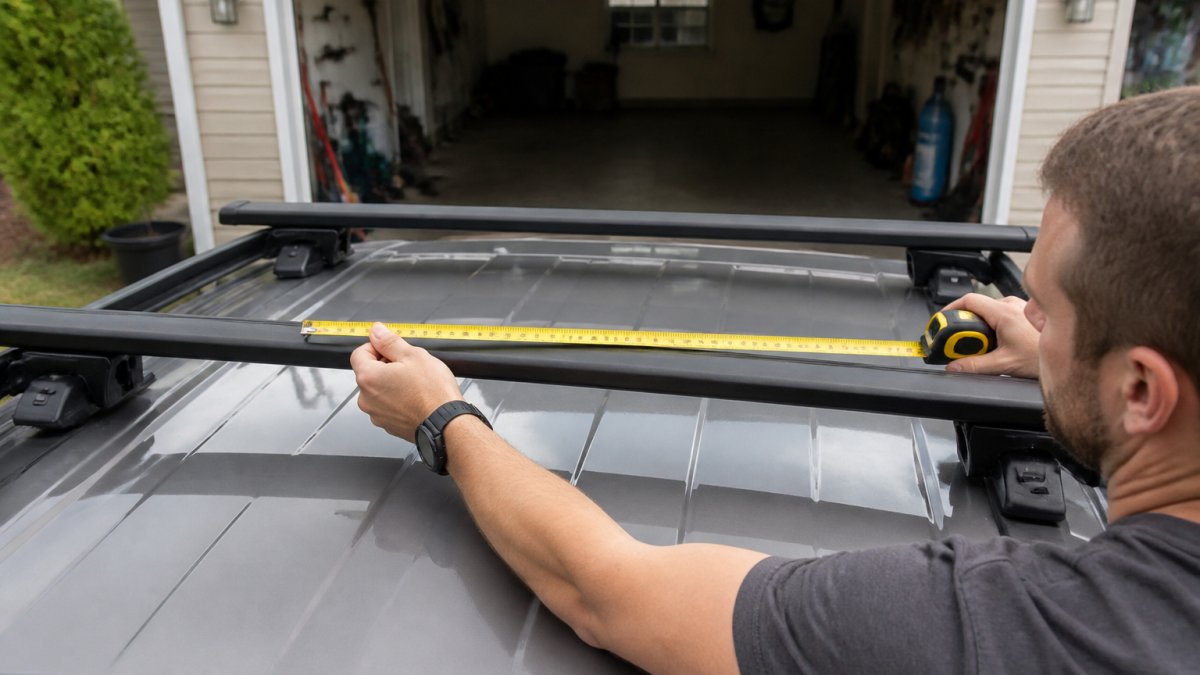
Most hard shell tents want crossbars set a specific distance apart. Too narrow and the tent overhangs the bars. Too wide and the rails won't reach. Record both numbers:
- Crossbar spacing, center to center
- Tent mounting rail spread
- Bar width and profile
Also note your mounting points: factory fixed points, roof rails, or aftermarket tracks. Each needs different hardware. Confirm the tent ships with brackets that match your setup, or plan to buy an adapter.
Step 5: Work Through a Full Load-Capacity Calculation
This is where fitment gets real. Run the numbers before you commit.
Roof Top Tent Hardshell Rooftop Tent for Van SUV Truck Car Overland Tent →
Here's a worked example. Say your vehicle's dynamic roof load is 165 pounds. Your rack weighs 20 pounds.
- Rack: 20 lb
- Tent: 130 lb
- Gear inside tent: 30 lb
That's 15 pounds over the 165-pound limit. The fix: strip gear from the tent before driving, or choose a lighter tent.
Use this checklist for your own rig:
- Vehicle dynamic roof load: ______ lb
- Rack weight: ______ lb
- Tent weight: ______ lb
If the total clears the limit with room to spare, you're in good shape. If not, adjust before buying.
Step 6: Check Rooftop Tent Dimensions and Overhang
Rooftop tent dimensions and overhang affect more than looks. Measure the tent's closed footprint and its open footprint. Then check overall height with the tent mounted.
Key measurements:
- Closed length and width vs. your roof area
- Open footprint, including any overhang past the windshield or rear
- Overall height, for garage and drive-through clearance
A tent that overhangs the front can block your view or catch wind. One that overhangs the rear can interfere with the tailgate. Measure your garage opening too. Plenty of buyers mount a tent, then discover it won't fit through the door.
Step 7: Troubleshoot Fitment Conflicts and Confirm With the Manufacturer
Specs conflict more often than you'd expect. The vehicle manual says one thing, the rack says another, and the tent listing says a third. When that happens, the lowest rating wins, and a call to the manufacturer settles it.
Resolve the common conflicts
| Problem | Likely Cause | Fix |
|---|---|---|
| Rack rated lower than roof | Weak crossbars or towers | Upgrade rack or pick lighter tent |
| Tent rails don't match bar spacing | Wrong bracket kit | Order adapter from tent maker |
| Manual silent on tents | Older vehicle, vague specs | Confirm in writing with dealer |
| Overhang blocks hatch | Tent too long for roof | Choose shorter model |
| Crossbars too close together | Rack installed at minimum spacing | Reposition bars to the tent maker's required spread, or add a third bar if the rack allows |
| Clamps can't clear the tent base | Tent base wider than bar span | Use a tent with a narrower base or a rack with wider crossbars |
| Unsupported overhang past the bars | Tent longer than the bar spread | Add a third crossbar or choose a shorter tent, never let the tent cantilever unsupported |
Watch out: a verbal "should be fine" from a salesperson isn't confirmation. Get it in writing, especially for older vehicles with non-standard racks. If you're unsure, ask the tent manufacturer directly with your make, model, year, and rack specs. They answer these questions daily.
What changes after installation
Fitment doesn't end when the bolts are tight. A rooftop tent changes how the vehicle drives, and the first few trips will tell you whether the setup is truly sound.
- Wind resistance and handling. A deployed or even closed hard shell tent adds frontal area and raises the center of gravity. Expect slower acceleration, longer braking distances, and more sensitivity to crosswinds. Reduce speed in gusty conditions and on highway on-ramps.
- Speed guidance. Many tent and rack makers publish a maximum driving speed with a tent mounted, often lower than the vehicle's normal limit. Check both the tent and rack documentation and follow the lower figure.
- Load security. Recheck all mounting bolts and clamp tensions after the first 50 miles and again after any rough-road segment. Vibration loosens fasteners that felt tight in the driveway.
If a conflict can't be resolved with the documentation you have, don't install. The cost of waiting for a written answer is far lower than the cost of a roof failure at speed.
Match Your Measurements to a Marvelous Sales Rooftop Tent
Once your numbers check out, pick a tent that matches them. Our hard shell lineup is built for real-world fitment, with a universal mounting system and a 60-second hydraulic-assist pop-up setup.
Three options to compare against your measurements:
- Roof Top Tent Hardshell for Van, SUV, Truck, 2-3 Person with Ladder at $1,239.99: sleeps 2-3, mounts to vehicle roofs, includes ladder
- Roof Top Tent Hard Shell Pop-Up for SUV and Campervan, 2-3 Person at $1,689.99: fits most SUVs and campervans, quick pop-up setup
- Hard Shell Rooftop Tent Pop-Up for SUV, Caravan, Campervan, 2-3 Person at $1,549.99: durable hard shell, roomy interior for overland travel
For more on matching a tent to your rig, see our rooftop tent buying guide. And if you're weighing roof load rules, the NHTSA publishes vehicle safety guidance worth a look.


Frequently Asked Questions
How do I know if my vehicle can support a rooftop tent?
Start with the maximum roof load printed in your vehicle owner's manual, then subtract the weight of your roof rack and crossbars. What remains is your usable dynamic capacity. Compare that to the tent's published weight plus any gear you plan to store up top. If the tent and rack combined exceed the vehicle's dynamic rating, the setup is not safe to drive with, even if the tent physically bolts on.
What is the difference between dynamic and static roof load capacity?
Dynamic roof load capacity is the weight your roof can carry while the vehicle is moving, and it accounts for braking, cornering, and road vibration. Static load is the weight it can hold when parked. Static ratings are much higher, which is why people can sleep in a tent that would be unsafe to drive with if it were heavier. Always use the dynamic number when checking rooftop tent fitment, and never compare your tent weight to the static figure.
Can a rooftop tent overhang the roof rack or crossbars?
Some overhang front to back is normal, but it must stay within the tent manufacturer's stated limits and must not block your windshield view, headlights, or antenna. Side-to-side overhang is the bigger concern because it changes your vehicle's width and center of gravity. Measure the tent's open and closed footprint against your crossbar span, and keep the weight centered between the mounting points rather than hanging off one end.
Do I need crossbars to install a rooftop tent?
Most rooftop tents mount to crossbars, so you usually need a rack rated for the tent's weight. Factory roof rails alone often are not enough because the rails carry a lower load than a full crossbar system. Check that your crossbars are spaced within the tent's mounting channel range and that the bar capacity, not just the vehicle roof rating, covers the combined load of tent, hardware, and occupants' gear.
Your roof, rack, and tent all have limits, and fitment is about respecting the lowest one. We built Marvelous Sales around gear that removes the guesswork: universal mounting, fast pop-up setup, and 30-day returns if the fit isn't right. Get started with Marvelous Sales and camp with confidence, knowing your setup is measured, checked, and ready for the trail.